Developer Tools
Hardhat vs Foundry for Smart Contract Development
Compare Hardhat and Foundry across compilation, local testing, deployment, scripting, debugging, and team workflow without relying on fragile version claims.
Ketan Kachariya 4 min read
On This Page
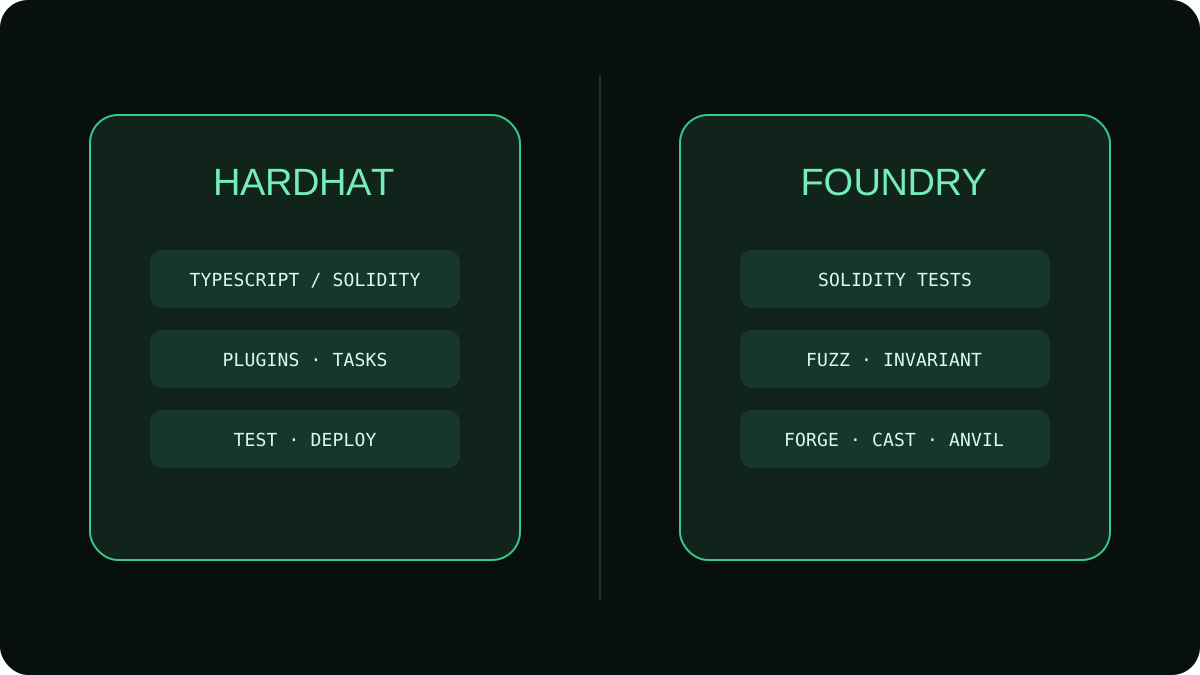
Hardhat and Foundry are development toolchains for Ethereum software, not competing smart contract languages. Both can compile Solidity, run local tests, execute deployment workflows, and support debugging. The meaningful difference is how a team prefers to express automation and tests, which ecosystem it already uses, and what its delivery pipeline needs. Tool capabilities evolve, so this comparison focuses on stable workflow characteristics and recommends checking the official documentation for the version installed in a project.
Two capable workflow shapes
Hardhat is centered on a configurable Node.js environment with a broad plugin ecosystem. It fits naturally when a project already uses TypeScript for frontend integration, deployment tooling, or end-to-end tests. Current Hardhat workflows can support TypeScript tests and Solidity tests, depending on the selected setup and plugins. Foundry is a Rust-based toolkit whose Forge command emphasizes Solidity-native tests, scripts, traces, fuzzing, and invariant testing. Cast provides command-line interaction with RPC endpoints and contracts, while Anvil supplies a local development node.
Compilation and local networks
Both toolchains manage compiler versions, artifacts, caches, and local EVM execution. A team should pin compiler configuration, optimizer settings, and EVM targets rather than depend on workstation defaults. Local networks accelerate deterministic tests and can simulate accounts, blocks, timestamps, and failures. Forked state is useful for integration work with deployed protocols, but pin a block and document external assumptions so tests remain repeatable. The choice of local node matters less than whether the suite resets state and produces explainable traces.
JavaScript/TypeScript and Solidity-oriented testing
Hardhat is often chosen for TypeScript tests that resemble how a web client calls a contract, making complex fixtures and integrations comfortable for JavaScript teams. Modern Hardhat setups can also run Solidity tests. Foundry makes Solidity tests a first-class default, so unit tests, fuzz tests, and invariants stay close to contract types and semantics. Neither language automatically produces better tests. TypeScript can express orchestration clearly; Solidity can reduce translation between test and contract behavior. Many teams combine focused Solidity properties with client-level TypeScript integration tests.
# Typical commands; confirm options for the installed versions
npx hardhat compile
npx hardhat test

forge build
forge test -vvv
anvil
Deployment and scripting
Hardhat scripts run inside its runtime and can use ethers.js, viem, tasks, plugins, or declarative deployment modules such as Hardhat Ignition. Foundry scripts are written in Solidity and can simulate and broadcast transaction sequences through Forge. In either system, deployments need chain-aware configuration, protected secrets, reproducible arguments, verification, and recorded addresses. A script that works once from a developer laptop is not yet a release process; test it against a local network and testnet, then integrate review and confirmation into automation.
Debugging and traces
Both environments can surface revert reasons and execution traces. Foundry's verbosity levels and Solidity-oriented traces are especially direct for contract-centric investigation. Hardhat integrates debugging into its task and plugin environment and can be convenient when the failing path crosses TypeScript fixtures or application tooling. Good debugging starts with a minimal failing test, pinned state, and named actors. Console logging can help locally but should not substitute for assertions, events, or trace analysis.
Choose by project constraints
- Choose a Hardhat-centered setup when TypeScript integration, Node tooling, or a specific maintained plugin is central to the team.
- Choose a Foundry-centered setup when Solidity-native tests, fast command-line iteration, fuzzing, and invariant workflows match the team's habits.
- Use both when each owns a clear part of the pipeline and duplicate compilation or configuration is controlled.
- Evaluate maintenance, CI support, team familiarity, and reproducibility—not benchmark claims copied from another project.
- Pin versions and review migration notes before adopting examples from older tutorials.
Run a representative toolchain evaluation
A useful comparison starts from one small contract package, not a synthetic hello-world benchmark. Implement the same unit tests, one fuzzed property, one deployment, and one verification flow in each candidate environment. Run both setups in a clean CI worker and document the commands, caches, environment variables, and artifacts they produce. Then ask a teammate who did not build the prototype to reproduce a failure and deploy to a local node. This exposes onboarding and debugging costs that raw execution timing cannot show.
Treat interoperability as a design decision when both tools are retained. Select one authoritative source for compiler settings and dependency versions, decide which system produces deployable artifacts, and prevent generated directories from silently feeding stale output into the other. CI should fail when the two pipelines disagree on tests or bytecode. A mixed setup can be powerful, but only when ownership is explicit; otherwise every upgrade creates two migration paths and reviewers cannot tell which command represents the release.
A toolchain should make evidence easy
The best environment is the one that lets the team write meaningful tests, inspect failures, reproduce deployments, and keep configuration reviewable. Start with the smaller setup, add plugins only for a concrete need, and keep contract correctness independent of a vendor-specific convenience. Hardhat and Foundry can both support professional work; disciplined specifications, tests, and release practices remain the deciding factors.
Building a Web3 Product?
Need help with a DApp, smart contract integration, wallet connection, or production Web3 architecture? Let's discuss the engineering behind your product.
Discuss Your Web3 ProjectKeep Reading
Related Articles
Solidity
Solidity Smart Contract Development Guide
Understand Solidity contract structure, EVM execution, visibility, events, custom errors, access control, testing, and responsible deployment workflows.
Blockchain Security
Smart Contract Security and Testing Guide
A defensive engineering guide to access control, reentrancy, external calls, validation, approvals, oracles, test coverage, fuzzing, and independent review.
Smart Contracts
ERC-20 vs ERC-721 vs ERC-1155
Compare Ethereum token standards for fungible assets, unique NFTs, and mixed multi-token collections, including interfaces, approvals, and design risks.