Blockchain
Understanding Ethereum, the EVM, and Smart Contracts
A developer-focused explanation of Ethereum accounts, transactions, EVM execution, gas, RPC access, confirmations, and EVM-compatible networks.
Ketan Kachariya 4 min read
On This Page
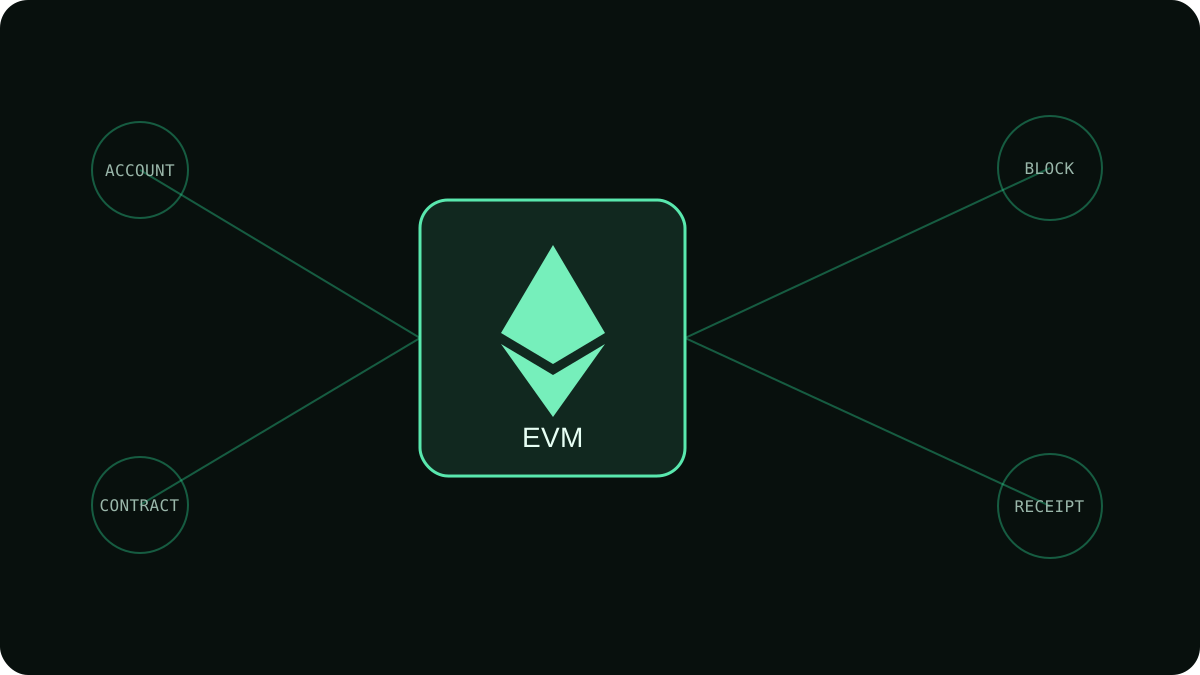
Ethereum is a distributed state machine shared by many independent nodes. Users and applications submit signed transactions, validators include valid transactions in blocks, and every node executes the same state transition rules. Smart contracts are programs stored at addresses inside that state. The Ethereum Virtual Machine, or EVM, provides the execution environment. Understanding these layers helps a developer separate a wallet problem from an RPC problem, a contract revert from a dropped transaction, and Ethereum behavior from the behavior of another network that merely uses the EVM.
Accounts and transactions
Ethereum has externally owned accounts controlled by keys and contract accounts controlled by code. An externally owned account initiates a transaction by signing data that includes the destination, value, calldata, gas settings, chain ID, and nonce. A contract cannot wake itself up; its code runs when a transaction or call reaches it, directly or through another contract. The account nonce orders transactions from one sender and prevents replay within the same chain context. A valid signature authorizes the request, but the EVM still applies contract rules and can revert it.
What the EVM executes
The EVM is a deterministic, sandboxed machine with its own instruction set, stack, memory, persistent storage, and call model. Solidity is compiled into EVM bytecode; it is not interpreted by nodes as Solidity source. During execution, memory exists only for the call, while storage changes can persist after a successful transaction. Calls can invoke other contracts, create contracts, emit logs, return data, or revert. The same bytecode and input must produce the same result for every node, which is why contracts cannot directly depend on an arbitrary web API or local clock.
Gas measures execution work
Each EVM operation has a gas cost. The sender sets a gas limit that caps the work a transaction may consume and fee parameters that influence inclusion. Unused gas is not charged as executed work, but a transaction that runs out of gas reverts its state changes while the consumed computation still requires a fee. Gas is not a direct measure of code quality, yet storage writes, loops over growing collections, and unnecessary external calls can make an interface expensive or unusable. Optimize after measuring and never trade clear authorization rules for a small fee reduction.
RPC providers are gateways, not the chain itself
Applications usually communicate with an Ethereum node through JSON-RPC. An RPC provider may be self-hosted or managed, public or authenticated. It exposes methods for reading blocks, simulating calls, estimating gas, sending signed transactions, and retrieving receipts or logs. Providers can be delayed, rate-limited, misconfigured, or temporarily inconsistent. A production application should validate the reported chain ID, use timeouts and retry policies for safe reads, avoid automatic write retries, and monitor multiple signals rather than assuming one endpoint represents perfect network truth.
{
  "jsonrpc": "2.0",
  "id": 1,
  "method": "eth_getCode",
  "params": ["0xContractAddress", "latest"]
}
Blocks, finality, and confirmations
A transaction becomes mined when it is included in a block. Applications often wait for additional blocks before treating a high-consequence action as settled because the canonical chain can change near the head. The appropriate confirmation policy depends on the network and the action; it should be configuration, not a universal magic number. A receipt reports execution status and logs for an included transaction. Pending status means neither success nor failure, and a transaction hash alone is not a receipt.
Ethereum versus EVM-compatible networks
Ethereum is a specific network with its own consensus, economics, upgrade process, and security properties. An EVM-compatible network supports the EVM instruction model and familiar tools, but it may use different fee rules, block timing, finality, precompiles, bridging assumptions, or transaction types. Contract bytecode portability does not guarantee identical operational behavior. Always use the target chain's documentation, test the actual RPC and wallet flows, and keep addresses and chain IDs separate across environments.
- Verify the active chain ID before selecting a contract address.
- Check that expected bytecode exists at configured addresses.
- Treat RPC responses, wallet state, and indexed data as related but distinct views.
- Wait for an appropriate confirmation policy before final UI state.
- Test every supported network instead of assuming EVM compatibility is complete equivalence.
Observe the system across its boundaries
Operational telemetry should preserve the distinctions in the architecture. Measure RPC availability and latency by chain and method, record transaction hashes for submitted writes, track how long receipts and chosen confirmations take, and monitor indexer distance from the canonical head. Correlate those signals with an application operation ID without logging signatures or unnecessary wallet history. When support investigates a report, it should be possible to determine whether the interface used the wrong configuration, the wallet rejected a request, the RPC failed, the EVM reverted, or an off-chain projection simply had not caught up.
Use the layers to diagnose real applications
When a DApp fails, ask which layer owns the evidence. The wallet controls account permissions and signatures. The provider transports requests and reports chain data. The EVM executes bytecode. The contract enforces application rules. Blocks and confirmations determine settlement. Keeping those responsibilities distinct leads to clearer monitoring, safer retries, and user messages that explain the actual problem rather than blaming an undefined blockchain.
Building a Web3 Product?
Need help with a DApp, smart contract integration, wallet connection, or production Web3 architecture? Let's discuss the engineering behind your product.
Discuss Your Web3 ProjectKeep Reading
Related Articles
Solidity
Solidity Smart Contract Development Guide
Understand Solidity contract structure, EVM execution, visibility, events, custom errors, access control, testing, and responsible deployment workflows.
Web3 Development
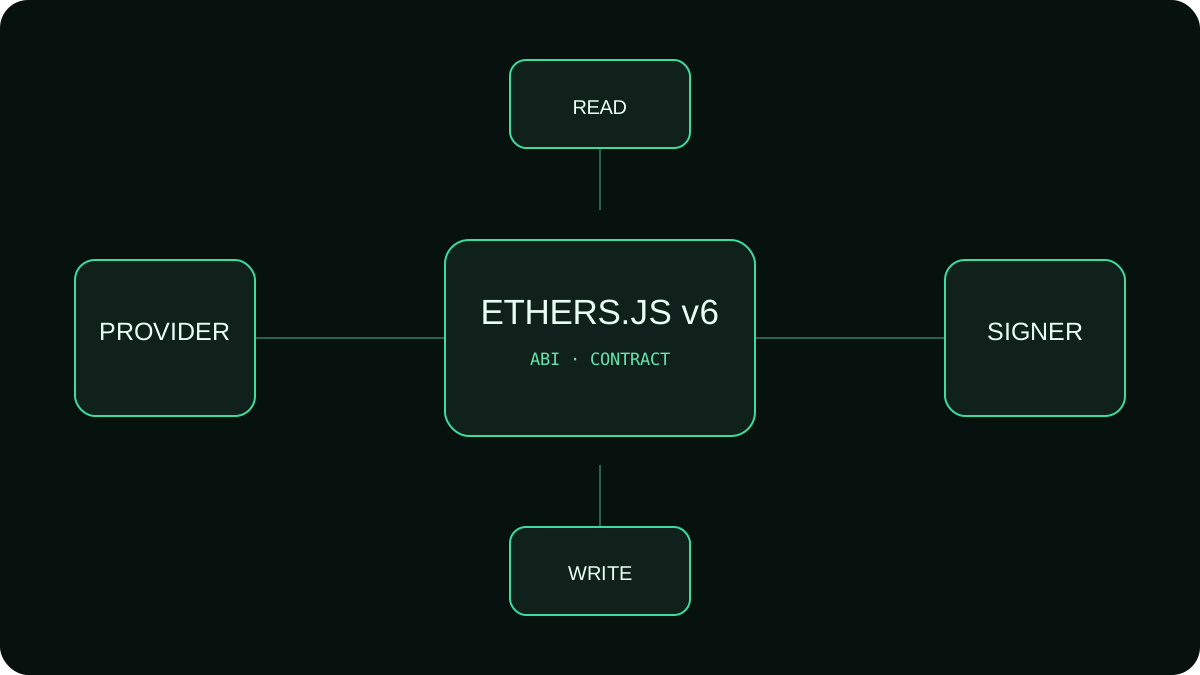
Ethers.js v6 Smart Contract Integration
Use Ethers.js v6 providers, signers, ABIs, contract reads, transaction writes, confirmations, and chain checks without mixing v5 patterns.
Ethereum
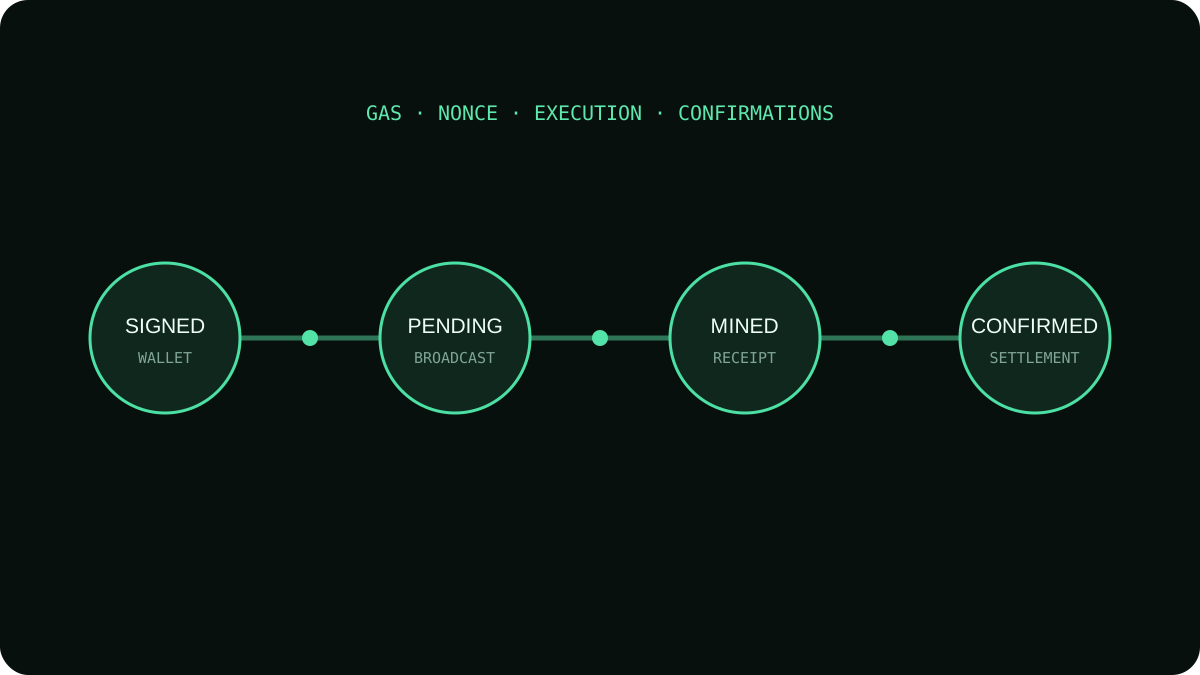
Ethereum Gas Fees, Transactions, and Confirmations
Follow an Ethereum transaction from wallet signature to confirmation, including gas units, fee estimation, nonces, replacement, reverts, RPC failures, and UX.