01 / Web3 Development
Web3 Wallet & Portfolio Dashboard
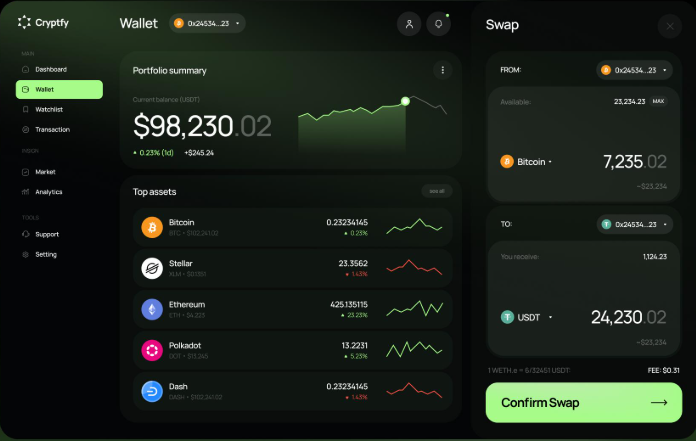
A modern Web3 dashboard concept designed to connect cryptocurrency wallets, display token balances, track blockchain transactions, and visualize wallet activity across supported networks.
Concept · Concept UI- My Role
- Web3 Product & Architecture Concept
- Project Type
- Web3 Wallet Application
- Status
- Concept
01 / Overview
System overview
The proposed dashboard coordinates injected-wallet state with RPC reads, normalizes balances and activity, and presents the result through a responsive portfolio interface with explicit network and transaction feedback.
My Role
Web3 Product & Architecture Concept
Defined the proposed architecture, workflow boundaries, interface states, and implementation approach documented in this concept study.
02 / Problem
The product and protocol challenge
Wallet data is fragmented across networks, token contracts, and transaction explorers, making it difficult to understand one address at a glance.
03 / Solution
The engineering approach
The proposed dashboard coordinates injected-wallet state with RPC reads, normalizes balances and activity, and presents the result through a responsive portfolio interface with explicit network and transaction feedback.
04 / Architecture
System flow
A responsive view of the main runtime boundaries and data path.
05 / Core Components
Responsibilities by component
Wallet Connector
Coordinates account access, chain changes, and disconnect states.
Portfolio Reader
Aggregates native and token balances into a normalized view.
Activity Feed
Presents transaction history and confirmation state.
Analytics UI
Turns wallet activity into legible summaries and charts.
06 / Key Features
Product and platform capabilities
- MetaMask connection with network detection and switching
- Token balances, portfolio summaries, and transaction history
- Responsive loading, error, and transaction-status states
07 / Engineering Decisions
Challenge, decision, and rationale
Challenge
Keep chain state current.
Decision
Listen for account and network events.
Why
Prevents stale balances after wallet-side changes.
Challenge
Handle unreliable RPC reads.
Decision
Model loading, empty, retry, and error states explicitly.
Why
Makes provider failures understandable to users.
08 / Challenges
Implementation pressure points
- Normalizing token metadata and decimals
- Keeping wallet and interface state synchronized
- Presenting pending and confirmed transactions clearly
09 / Data & Infrastructure
Operational foundation
- Ethereum JSON-RPC for supported networks
- Client-side provider state
- Optional indexed transaction API for historical activity
10 / Security & Reliability
Controls that protect the workflow
- No private-key custody
- Human-readable network and transaction prompts
- Read-only fallbacks when wallet access is unavailable
11 / Concept Mockups
Proposed product interface
These labeled concept visuals communicate interface direction; they are not screenshots of a functioning application.
12 / Technology Stack
Tools grouped by purpose
Frontend
Web3
13 / What I Learned
Project-specific takeaways
- Provider lifecycle design
- On-chain data normalization
- Wallet-first responsive UX
14 / Outcome
Engineering outcome
- Defined a credible wallet dashboard architecture
- Mapped the complete wallet connection and activity workflow
- Produced a labeled concept interface for future implementation
15 / Access
Public demo and source availability
This is currently a portfolio concept. No public demo or repository has been supplied, so external project actions are intentionally hidden.
16 / Related Project
Continue exploring
Have a Similar Web3 Project?